Why Marketing Measurement Is Broken — and What Outcome Intelligence Does Instead
The modern marketer has never had access to more data. And yet, the gap between what gets measured and what actually moves the business has never felt wider. Clicks, impressions, view-through rates, last-click conversions — these numbers fill dashboards and populate end-of-quarter slides. But ask a CMO whether their media spend actually caused growth — whether campaigns drove real people into real stores and changed real purchase behavior — and you’ll often be met with a long pause.
That pause is costing brands billions. And it’s a symptom of a deeper structural problem: the measurement frameworks most marketers rely on were never designed to answer the questions that matter most.
The Measurement Problem Hiding in Plain Sight
Marketing attribution has been the industry’s default answer to accountability for over a decade. Last-click, first-click, multi-touch, data-driven — each model promises to tell you which media channels and campaigns deserve credit for a conversion. And each one, in its own way, falls short of delivering what marketers actually need: proof that their media spend drove incremental business growth.
The challenges of marketing attribution are not just technical. They are fundamental. Attribution models assign credit — they don’t establish causation. A consumer who was served a retargeting ad and then converted may well have converted anyway. A brand campaign that appears to underperform in a last-click model may be the reason someone walked into a store three weeks later. The model doesn’t know. And increasingly, neither does the brand.
The result is a measurement framework built on proxies: metrics that are easier to track than the outcomes they’re meant to represent. Vanity metrics — impressions served, click-through rates, reach and frequency figures — have become stand-ins for business impact. They are reported with confidence because they are measurable, not because they are meaningful.

Here is the number that reframes the entire conversation: InMarket analyzed 109 campaigns and found that those in the bottom quintile — not yet actively optimizing — wasted more than 60% of their media spend on average. More than half of the media investment brands make every quarter is generating no measurable improvement in the outcome that actually matters — purchase behavior. The waste is not an edge case. It is the norm. And the reason it persists is that most measurement arrives as a post-mortem, after the budget is gone and the opportunity to redirect has passed.
This is not a data problem. Brands have more data than ever. It is a measurement effectiveness problem — a failure to connect the right signals to the right outcomes at the right time.
What Incrementality Actually Means — and Why It Changes Everything
Incrementality is the discipline of isolating what media actually caused versus what would have happened anyway. It is not attribution. It is not correlation. It is the controlled, rigorous process of asking: if this campaign had never run, would this consumer have bought anyway?
The distinction is not semantic. A brand running a retargeting campaign against its most loyal, highest-intent customers may see excellent attribution numbers — because those customers were going to buy regardless. The campaign looks like a winner. The incrementality test reveals it was reaching people already in motion, not moving people who weren’t. In that scenario, the marketing budget is being spent to take credit for outcomes it didn’t create.
Understanding incrementality in marketing means shifting the measurement standard from who converted to what caused the conversion. It means building a measurement framework grounded in causation — one that can tell a brand not just that media spend correlated with sales, but that it drove sales that wouldn’t otherwise have occurred.
This is where most measurement approaches fail — and where the gap between reporting and intelligence becomes most visible. A marketing incrementality test is a controlled experiment: a treatment group that receives media exposure, a holdout group that doesn’t, and a rigorous comparison of outcomes between them. When run at scale across platforms and channels, it becomes the foundation for understanding what is actually working.
The brands that operationalize incrementality testing at scale — running thousands of tests annually across TikTok, Snapchat, Pinterest, Amazon, and more — gain something their competitors don’t have: a real, defensible picture of media value. Not an estimate. Not an attribution model’s best guess. A verified proof of business impact.
That proof matters most when budgets are under pressure, when CMO tenure averages under two years, and when every major spending decision needs to be defended to a board that is increasingly skeptical of marketing’s ability to demonstrate ROI.
From Metrics to Outcomes: What a New Standard Looks Like
Measuring marketing effectiveness as just described requires more than a better attribution model. It requires a fundamentally different approach to what gets measured, when measurement happens, and what the output of that measurement is designed to do.
The first shift is from delivery metrics to outcome metrics. Impressions served, clicks generated, and reach achieved are delivery metrics — they confirm that media ran. They do not confirm that media worked. Outcome metrics — store visits, sales lift, incremental revenue generated — connect media investment to real-world business results. They are harder to capture, but they are the only metrics that answer the question a CFO or a CEO actually cares about.
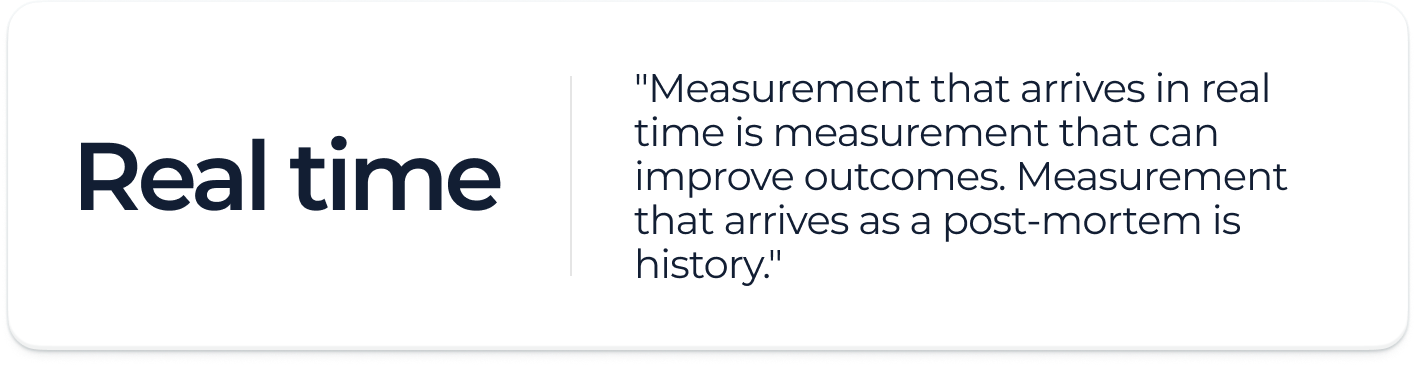
The second shift is from post-campaign reporting to in-flight intelligence. The standard model of marketing measurement delivers findings after the campaign ends: a retrospective analysis that explains what happened but arrives too late to influence what happens next. In-flight intelligence delivers a signal within days of a campaign going live — while there is still budget to redirect, creative to swap, and audience targeting to adjust. Measurement that arrives in real time is measurement that can improve outcomes. Measurement that arrives as a post-mortem is history.
The third shift is the move from siloed channel measurement to a unified buyer picture. Walled gardens and fragmented platforms make it structurally difficult for brands to see a complete view of how media exposure across screens and channels translates into purchase behavior. A consumer might see a CTV ad on Monday, encounter a social campaign on Wednesday, and walk into a store on Friday. Without a unified signal set that connects those touchpoints to the outcome, the brand is measuring fragments — and likely attributing the conversion to whichever fragment happened last.
These three shifts — from delivery to outcomes, from post-mortem to in-flight, from fragmented to unified — define what modern marketing measurement should look like. They are also, together, what separates a metrics platform from an intelligence platform.
Introducing Outcome Intelligence: The Platform That Closes the Loop
Outcome Intelligence is the framework that connects every media dollar to the business result it created — and delivers that connection in time to act on it. It is not a measurement product. It is a system that spans activation, measurement, and audiences, powered by real buyer signals, AI-driven optimization, and a signal network that reaches over 100M+ consumers.
The core capability of Outcome Intelligence is the closed loop: the ability to connect an ad impression served on any screen to a purchase made at any register, at the transaction and item levels — not as an aggregate estimate, but as a real, verifiable number. That number — what InMarket calls iROAS —makes media accountability real rather than theoretical.
For brands, Outcome Intelligence delivers three things that conventional measurement cannot:
- Independent measurement free from media buying incentives. When the platform that measures your media performance also sells you that media, there is a structural conflict of interest. Outcome Intelligence is accountable to the brand — not the agency or the platform.
- In-flight intelligence that arrives within 3 days of a campaign launch. Not a retrospective. A live signal that tells brands what is working, what is wasting spend, and where to redirect budget while it still matters.
- AI-driven marketing attribution that goes beyond model-based credit assignment to verify real-world outcomes through incrementality testing at scale.
For agencies, it provides the ground truth that validates every buy — proof of performance that is independent, defensible, and connected to outcomes that clients can actually see in their business results.
For publishers and platforms, it offers something increasingly rare: a verification layer that confirms whether their inventory is driving real business impact, not just delivering impressions.
Why the Window to Act Is Now
Three converging forces make the shift to Outcome Intelligence not just valuable but urgent.
First, media buying is becoming increasingly automated. AI agents are taking over planning, buying, and optimization workflows at a pace that most marketing organizations have not yet fully accounted for. When an AI is making the media decisions, the brand needs an independent system that validates whether those decisions are actually improving outcomes — or quietly compounding waste at machine speed.
Second, board-level scrutiny of marketing spend has never been higher. CMO tenure averages under two years. Every budget cycle is a test of whether the marketing function can demonstrate the connection between spend and growth. The brands that can prove that connection — with verified incrementality data, real iROAS figures, and Forrester-verified effectiveness improvements — are the brands whose CMOs have something to stand behind. The ones that can’t are defending dashboards full of delivery metrics against a room full of skeptics.
Third, the competitive advantage of owning this kind of measurement is real and compounding. Brands that build their measurement foundation on incremental outcomes — rather than proxy metrics and attribution models — make smarter budget decisions faster, waste less on media that isn’t working, and accumulate a clearer picture of what actually drives growth for their specific consumers. That knowledge does not degrade. It compounds.
The 60%+ waste figure is an industry reality. It is also an opportunity. The brands that close that gap — by deploying intelligence that connects media investment to real-world outcomes, runs incrementality tests at scale, and delivers in-flight signals rather than a post-mortem — are not just reducing waste. They are building a durable competitive advantage that compounds with every campaign.
What This Means for Brands, Agencies, and Publishers
Outcome Intelligence is not a technology story. It is a business story — and it looks different depending on where you sit in the marketing ecosystem.
For brand marketers, it is the shift from defending media spend to proving it. The ability to walk into a budget conversation with verified iROAS figures, incrementality-tested proof of campaign effectiveness, and a measurement framework independent of the incentives of whoever sold you the media — that is a fundamentally different posture. It is the difference between hoping your measurement tells a good story and knowing your media is driving real growth.
For agencies, it is the tool that turns performance claims into verifiable proof. As clients become more sophisticated about incrementality, and as AI-driven media buying makes it easier to automate spend but harder to explain outcomes, independent measurement becomes the service layer that differentiates a strategic partner from a buying desk.
For publishers and platforms, this validation framework moves inventory from a line item in a plan to a verified driver of business outcomes. Publishers that can point to independent outcome measurement as proof of their advertising effectiveness — not platform-reported metrics, but closed-loop incrementality — are selling something categorically different from those who cannot.
The Era of Outcome Intelligence
The era of vanity metrics is not ending because marketers have decided to demand more. It is ending because the pressure to demonstrate real business impact has become inescapable — from boards, from CFOs, and from a competitive environment where every dollar spent must prove its value.
Outcome Intelligence is the response to that pressure: a framework that replaces proxy metrics with verified proof, connects media investment to real-world results, and delivers the intelligence to act while there is still time to improve the outcome. It is powered by the scale to run incrementality tests across thousands of campaigns annually, the signal depth to connect every impression to a purchase, and the independence to deliver measurement that belongs to the brand — not to whoever sold them the media.
The question is no longer whether brands should demand this standard of proof. The question is how quickly they can build a measurement foundation capable of delivering it.

InMarket is the outcome intelligence platform that connects real buyer signals to measurable business results — across activation, measurement, and audiences. The brands winning the Outcome Era aren’t hoping their media worked — they can prove it. We’re here to help you get there. Get in touch at InMarket.com/Contact.