Prove It or Lose It: What Three Advertising Week Leaders Do Before They Spend $1
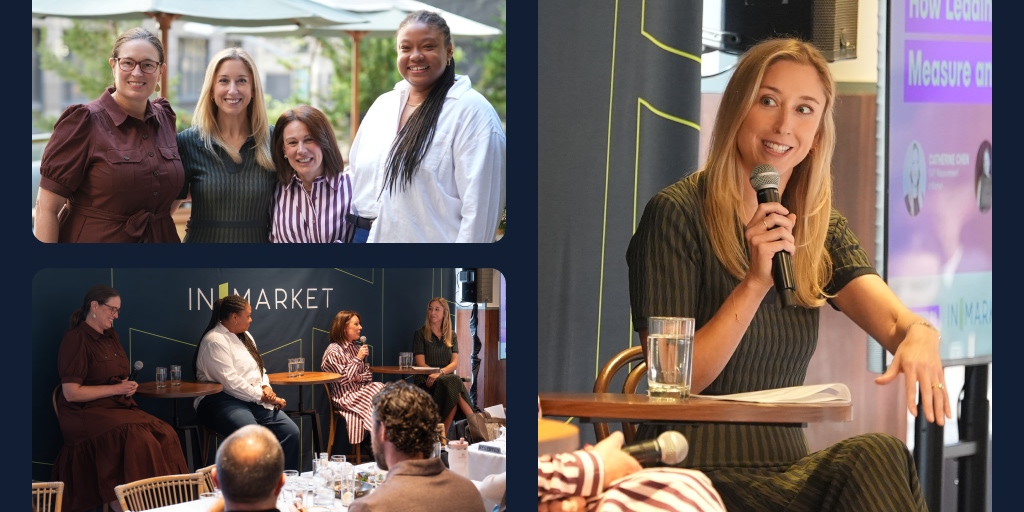
What iProspect, Pinterest, and Spark Foundry told our Advertising Week New York 2026 Lunch Club about proving media works.
Advertising Week New York 2026 (October 5-8, The Penn District) had plenty of talk about creators and AI, but one theme cut through it: the return of the real world. As the internet gets harder to trust and more AI-mediated, where people go, what they buy, and what they do offline are signals no algorithm can fake or filter. For InMarket, that’s familiar ground, and it shaped our week around Outcome Intelligence: tying media to real-world results like incremental sales, store visits, and iROAS.
With 2027 budgets being set now and fewer clicks to prove what your media did, we brought together leaders from iProspect, Pinterest, and Spark Foundry at our invite-only AW Lunch Club on Wednesday, October 7, at Bar Harta. The panel, Prove It or Lose It: How Leading Brands & Platforms Measure and Optimize Media, put agency, platform, and media investment seats at one table to ask how marketers show that media actually changed what people did. All three had advice for what to do before the first dollar goes out.
The panel
- Ali Sidrane, EVP, Managing Director, iProspect
- LeShaun Jones, Ads Measurement Partner, Pinterest
- Kelly Metz, Chief Investment Officer, Spark Foundry
- Moderator: Catherine Chen, SVP, Measurement, InMarket
Catherine opened by sharing how InMarket uses real-time intent, location, and item-level commerce data to reach people and measure the outcomes. From there, the panel dug into what makes those outcomes credible, and three ideas stood out.
1. Decide what you need to learn before you spend.
Get measurement design right first. Ali’s answer to ‘what’s the one thing to do before budgets lock?’ was direct:
“Before you spend $1, make sure that you understand exactly what it is that you are looking to measure and what you are looking to learn. Don’t go to measure it after the fact.” — Ali Sidrane, iProspect
LeShaun recommended building a learning agenda tied to your measurement framework, so you’re not over-relying on past performance. Kelly added the other half: leave room to act on what you learn.
“I like to see large chunks of money held to do very specific things.” — Kelly Metz, Spark Foundry
Catherine closed the loop for planners:
“Things move too fast to lock everything in at the beginning.” — Catherine Chen, InMarket
Her takeaway was to set up measurement that can capture whatever comes next, including things we can’t see yet.
2. No single number tells the whole story, so build a framework instead.
The panel also agreed that searching for one perfect source of truth across every channel does more harm than good. Different measurement methods answer different questions, and forcing them together backfires. As Ali put it:
“We almost create false precision when we try to make them all fit into a little box that they don’t actually fit into.” — Ali Sidrane, iProspect
LeShaun explained what gets lost in that box: high-reach media built for awareness and lower-funnel media built for action are judged by different measures, so a single view tends to shortchange one of them.
“A unified view is possible, but it will always devalue something.” — LeShaun Jones, Pinterest
The alternative is a shared framework. Ali’s version was the line of the day:
“A unified view, no, but a unified framework, absolutely.” — Ali Sidrane, iProspect
For iProspect, that means an audience-led approach that connects brand through to demand, “pulling every channel into an ecosystem that you can then optimize against, all towards business outcomes.”
3. Translate for the CFO: revenue and profit win budgets.
Ali boiled the CFO’s question down to one line:
“If I give you a dollar, what am I going to get in return?” — Ali Sidrane, iProspect
Her answer is to avoid campaign metrics like sales lift or site traffic in that conversation and translate them into lifetime customer value or actual sales. LeShaun added that a strong result only counts if it ties to what the business is trying to achieve:
“If it’s not tied to a business objective or what the CFO is using to make business decisions… it’s not as impactful.” — LeShaun Jones, Pinterest
Kelly kept it simple:
“They care about revenue, and they care about profit. That’s how you win.” — Kelly Metz, Spark Foundry
From the Panel to the Dashboard: Metrics That Matter
The Lunch Club conversation lines up with a change we’ve been making in our own measurement. For years, lift % has been the headline number in campaign readouts. Lift still matters. It tells you whether media changed behavior. But on its own, it can’t answer the next question every budget owner asks: was it worth the spend? A high lift % on a small base can drive less real value than a modest lift % on a large one.
That’s why InMarket’s approach around Metrics That Matter puts the focus on incremental outcomes, alongside lift:
- iROAS (incremental return on ad spend): the incremental sales your media drove for every dollar spent. It’s the revenue-and-profit language the panel said decision-makers are listening for.
- IPM (incremental sales or visits per 1,000 impressions): a new metric that works like a CPM for outcomes. It shows which audiences, creatives, and tactics are driving real-world results while the campaign is still running, so teams can shift budget in flight.
- Benchmarks beyond lift: for the first time in more than a decade, InMarket benchmarks go beyond lift % to include iROAS, IPM, and cost per incremental visit. Every result comes with context that answers the question marketers ask most: is this good?
The Bottom Line
Across the agency, platform, and investment perspectives, three themes were clear:
- Design before you spend. Define what you need to learn first, and hold budget for what you find.
- No single number tells the whole story. Build a framework, not a single view.
- Speak the CFO’s language. Translate results into revenue and profit.
Huge thanks to Ali, LeShaun, and Kelly for sharing their expertise, and to everyone who joined us for lunch or stopped by the InMarket Market. (Our matcha was a hit!) The Market showed how campaign tools across audiences, media activation, and measurement connect to real-world outcomes, and it doubled as the set for In The Know, our executive video interview series, with new episodes coming soon.
Does your last campaign’s lift hold up on iROAS and IPM? See where you stand.