Proof Beats Perception: In The Know with United Airlines’ Julia Fedor
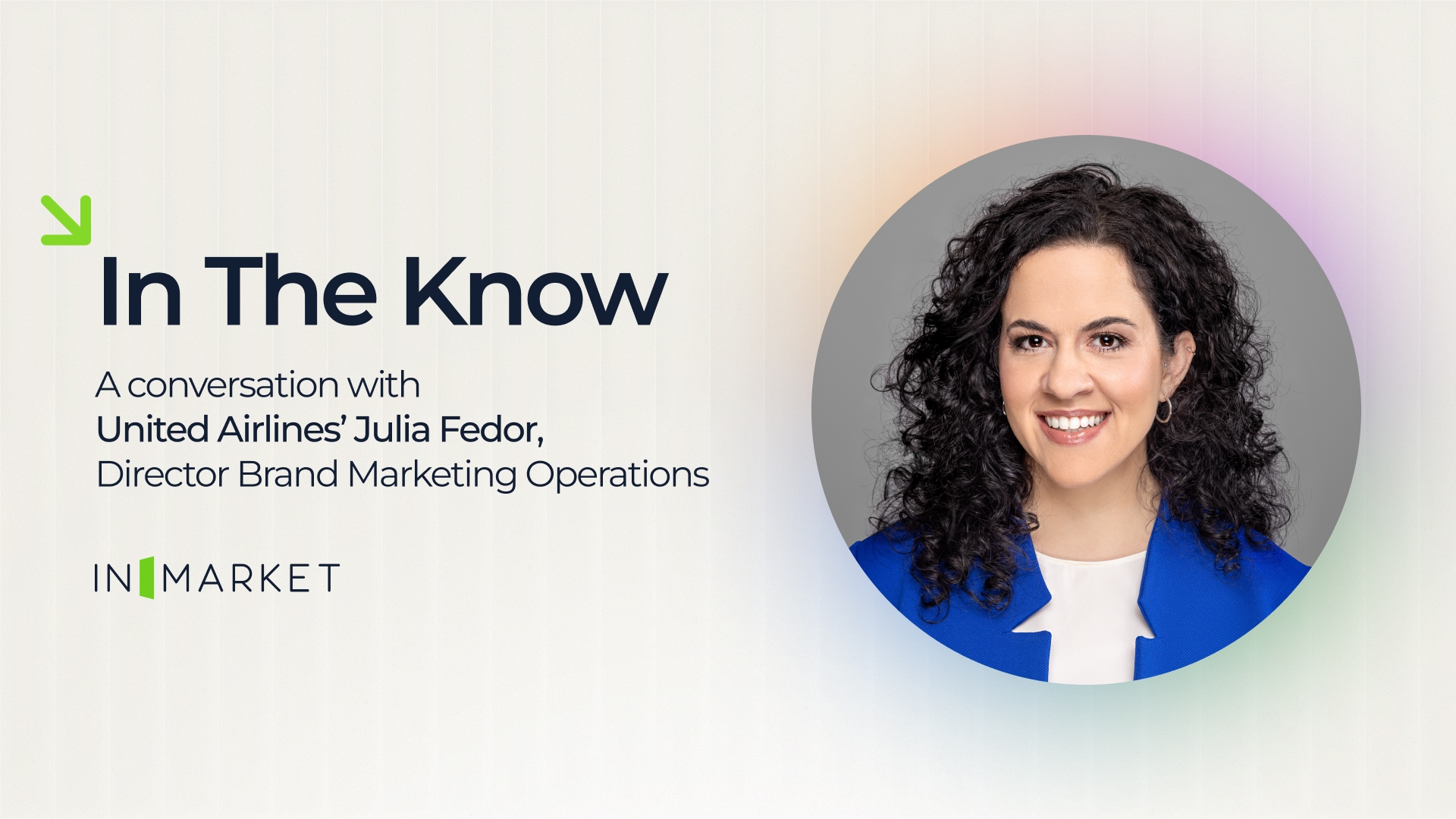
In the Know is a series that spotlights industry leaders sharing the ideas, strategies, and real-world insights driving meaningful impact in market. At Cannes 2026, InMarket sat down with Julia Fedor, Director, Brand Marketing Operations at United Airlines, to talk reinvention, loyalty, and proving marketing’s impact on the business. These key themes stood out:
A hundred-year history is only an asset if you still act like a challenger.
United celebrated its 100th birthday this April, but Julia’s organization doesn’t run their brand marketing team like a company protecting a legacy. They run their campaigns like a team that has to keep re-earning its place with travelers, or as she put it, more like a “five-year startup within a legacy brand,” especially post-pandemic.
The scale backs up that mentality. United became the world’s biggest airline a couple of years ago, flying almost 5,000 flights a day to more than 380 destinations worldwide, and served 175 million customers in 2025. That kind of reach could tempt a brand to coast. Instead, Julia’s team treats it as more surface area to defend, not less reason to compete for it.
Marketing earns trust by speaking finance’s language, not marketing’s.
Asked about her biggest challenge, Julia didn’t point to budget or creative fatigue. She named a translation problem: showing leadership that brand campaigns aren’t a line item; they’re a driver of airfare bookings and revenue.
“We want to show our head of finance that we actually helped the bottom line. Not just talk about performance KPIs, but how do we show that we’re not a cost center but a growth driver?”
It’s a reframe that changes the conversation entirely. Once marketing can draw a straight line from a campaign to bookings and revenue, it stops defending its budget and starts earning a seat in how the business plans its next move.
Brand health needs a regular pulse check, not an annual physical.
United used to survey brand perceptions once a year. Julia’s team replaced that with what she calls “an always-on consumer survey,” tracking airline brand preference, consideration, airline of choice, and whether the creative actually resonates and people feel seen in United’s advertising.
For a brand actively trying to shed old perceptions, an annual snapshot is too slow to catch a shift, and too slow to prove one worked.
The best growth lever was already sitting in word of mouth.
United’s Status Match program, letting travelers on a competitor airline transfer their loyalty tier, had existed for years but only ever spread organically. Last year, Julia’s team bought paid media and crafted bespoke creative for the first time, launching what United called the Switchers campaign in Chicago. It reached frequent flyers from competitor airlines, drove a massive uptick in status match applications, and was successful enough to replicate in Denver and New York.
Rather than inventing a new offer, the team found a brand trust mechanism customers already believed in, proved it in United’s hometown market, and turned it into a repeatable playbook for taking share city by city.
Commodity perception, not the airline next door, is the real competitor.
Asked how she thinks about differentiation, Julia named the real threat to United’s growth: not a specific competitor, but the assumption that every airline is interchangeable.
“There are a lot of travelers who view all the airlines as being the same, that we are a commodity industry. We’ve really been on a journey to show people that we’re actually different.”
That’s why her team leans on tangible proof points, an industry-leading app, product upgrades from the front to the back of their plane, and employees who go above and beyond for customers, rather than brand messaging alone. Perception doesn’t shift based on a slogan; it shifts from a flyer’s travel experience from booking to gate to arrival.
How that shows up in the work
Across every theme, the throughline is the same: Julia and United’s brand marketing team aren’t satisfied with reach or sentiment alone; they want proof the business can act on. That’s the same discipline InMarket’s Outcome Intelligence is built around, connecting media investment to the bookings, revenue, and loyalty shifts that actually move a business, not just the impressions along the way.
Connect with our team to see how InMarket can help you build custom, outcome-driven measurement for your brand. Get in touch at InMarket.com/Contact.