Know Where Your Incrementality Came From: Results Now Broken Out by Retailer Type
New Retailer Type Reporting in InMarket CPG Incrementality
Two campaigns can post the same incremental sales number and mean completely different things. One drove its lift in grocery, from repeat shoppers buying a second unit. The other drove lift in warehouse club, from a handful of bulk trips that inflated basket size. Same headline result. Very different implications for the next flight.
Most CPG incrementality measurement providers today cannot tell you which retailers drove which results. With InMarket CPG incrementality, we tell you which retailers moved product and, from September 2026 onward, which aggregated retailer type moved it.
Incrementality can’t tell you if you’re funding a grocery win or a warehouse club fluke—until now.
The gap we kept hearing about
Within InMarket CPG incrementality, those metrics have always broken out by individual retailers, up to the top 20 that drove sales for the campaign. That is genuinely useful: it tells you which specific grocery or convenience store outperformed, or which mass retailer underdelivered.
But brands do not plan exclusively at the retailer level. They also plan at the channel level. Channels set assortment, pack size, price architecture, shopper mission, and retail media strategy. And a retailer-by-retailer list does not answer the question a brand, agency, or shopper marketing team actually brings to a results review: did this work harder in warehouse club, convenience, grocery, mass, or dollar?
Answering that by hand meant stitching together disparate retailer reports, if those are even provided, and sorting chains into buckets in a spreadsheet. Brands did this inconsistently, and it is exactly the kind of manual work a measurement solution should absorb.
What’s new: Performance by Retailer Type
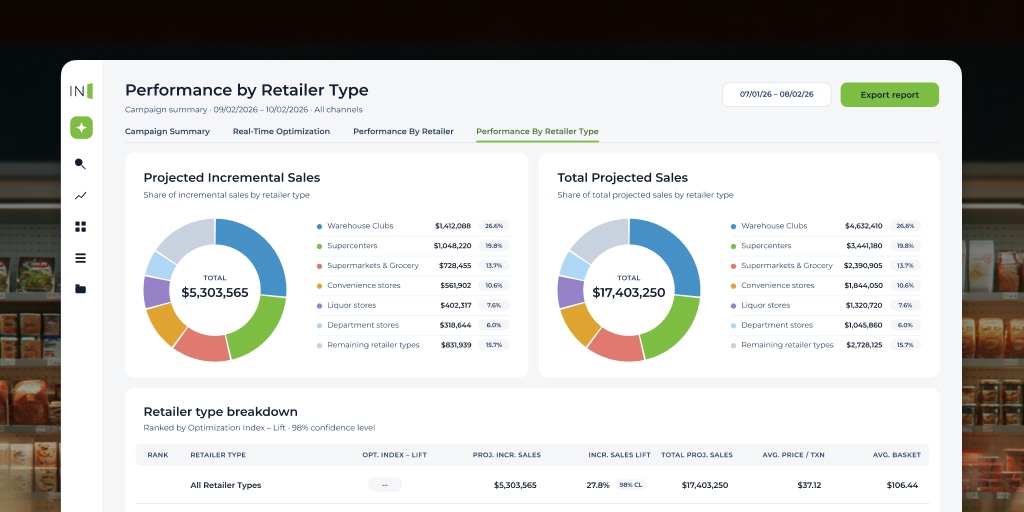
In this example, warehouse clubs account for 26.6% of projected incremental sales, a share that retailer-level reporting or total aggregated results alone would not surface as a channel story. Sample data shown for illustration.
A new Performance by Retailer Type view is now live across the InMarket CPG Incrementality results dashboard, PowerPoint outputs, and all data exports. It applies to CPG measurement campaigns that launched in September 2026 and onward.
Every metric you already see, grouped by channel. Incremental sales, total sales, incremental sales lift and confidence, penetration, incremental sales per 1,000 impressions, average price per transaction, average total basket amount, and average purchase frequency, all reported by retailer type. Same metrics, new lens.
Your retailer-specific reporting stays exactly the same. The existing Performance by Retailer view is unchanged. The new tab sits alongside it with the same familiar layout: summary panel, two share views, and a ranked table. There is nothing new to learn; the retailer column simply becomes retailer type. Brands get both views, not a trade-off.
Cleaner comparisons, by choice. You can now exclude an entire channel at campaign setup. The most common use case is warehouse club: bulk pack sizes pull average basket size and purchase frequency away from what a typical shopper trip looks like. Filtering out warehouse clubs makes the rest of the read comparable, a meaningful difference for brands whose warehouse club business behaves nothing like their grocery business.
Convenience becomes visible. Item-level convenience-store data feeds this breakout, which matters for categories where c-store is a real share of volume — beer, energy drinks, salty snacks, single-serve. These are categories that retailer-level reporting, dominated by the largest chains, has historically under-represented.
A quick refresher on CPG incrementality
Most advertising reporting answers a credit-claiming question: how many sales can this platform associate with its own impressions? That number tends to be generous, and it often double-counts when using total, raw sales.
Incrementality answers a harder and more useful question: what sales happened because of the campaign that would not have happened otherwise?
InMarket measures that with a synthetic matched control group design. Households exposed to a campaign are compared against a statistically matched set of unexposed households that look like them: same purchase history, same geography, same shopping patterns. The gap between the two groups is the lift the media actually created. Baseline demand, seasonality, and shoppers who would have bought anyway get stripped out.
That comparison runs against item-level purchase data covering $197B+ in observed spend, spanning nearly all major U.S. retailers and tens of thousands of brands. Because the data is item-level rather than category-level, results land on the specific UPCs a brand cares about, with weekly reads rather than a single post-campaign verdict, so teams can act while a flight is still live.
The output is a set of metrics brands can plan against: incremental sales and sales lift, penetration, average price per transaction, average total basket amount, average purchase frequency, and new-buyer understanding.
Why it matters for the next flight
Measurement shouldn’t only be about the scorecard. Perhaps more importantly, it is about the decision that follows.
Channel-level performance changes that decision in concrete ways. If dollar drove disproportionate incremental sales, that argues for shifting retail media weight and shopper support there. If warehouse club was a fluke due to frequency, that reframes what “success” looked like. If convenience converted a new-to-brand shopper on a single-serve pack, that is a trial story worth funding.
Individual retailer results tell you where you won. Retailer type tells you what kind of shopping trip your media influenced, and that insight carries into the next plan.
See it on your campaign
Wondering whether your last incrementality was really a grocery win or a warehouse club fluke? Performance by Retailer Type is live now for qualifying campaigns (those that launched September 2026 onward). If you’re already measuring with InMarket, reach out to your InMarket representative to walk through the new view on a current or upcoming flight.
If you’re evaluating incrementality measurement for the first time, request a demo, and we’ll show you what channel-level lift looks like on a brand in your category.